
The Automotive Industry and High-Performance Modified Nylon Materials
PA (Polyamide) possesses excellent comprehensive properties — not only is it easy to mold and relatively low in density, but it has also gained widespread and effective application in mold development and assembly. Furthermore, its outstanding thermal and electrical insulation properties have expanded the design scope of nylon materials, making them a frequent choice in the automotive sector for manufacturing various components.
The development trajectory of PA materials is closely intertwined with the automotive industry's pursuit of lightweighting, aesthetic enhancement, and functional optimization. Currently, PA materials are widely used in automotive engine systems, electrical systems, and chassis systems.
Among the various types of PA materials, PA6 and PA66 together account for over 90% of total consumption.
PA materials have a density of approximately 1.1–1.2 g/cm³, which is considerably lower than that of pure metals. Compared to the metal components they are designed to replace — such as zinc alloy die-cast parts, stainless steel, and aluminum alloy products — the use of PA materials can substantially reduce component weight. This, in turn, lowers vehicle fuel or electricity consumption, enhances overall handling performance, and effectively reduces carbon emissions.
Certain PA grades feature high melting points, with heat deflection temperatures reaching 100–150°C or above. After glass fiber reinforcement, their heat resistance is further improved, enabling stable performance in high-temperature environments.
PA materials offer good flowability and a wide processing window, allowing for molding through various processes including injection molding, extrusion, and compression molding. They maintain a consistent surface gloss over time, resisting discoloration and fading, and are well-suited to the demanding and harsh service conditions of automotive applications.
PA materials exhibit excellent fatigue resistance, maintaining good strength and toughness under repeated loading and cyclic stress conditions without being prone to failure.
With the advent of the pure electric era, the three-electric system — battery, motor, and electronic control — has become a critical benchmark for evaluating a vehicle's core performance. As new energy vehicle (NEV) three-electric systems have become mainstream, the application scenarios for PA nylon materials have undergone significant transformation.
PA46 features high crystallinity, along with high-temperature resistance, high rigidity, and high strength. It is primarily used in automotive engines and their peripheral components, such as cylinder heads, oil cylinder bases, oil seal covers, and transmissions. In the electrical industry, it is also applied in contactors, sockets, coil bobbins, switches, and other products that demand high heat resistance and fatigue strength.
PA6 offers excellent mechanical properties, stiffness, toughness, wear resistance, and mechanical damping, along with good electrical insulation and chemical resistance. It is widely used across automotive components, electronic and electrical parts, and many other fields.
Compared to PA6, PA66 exhibits superior mechanical strength, stiffness, heat resistance, wear resistance, and creep resistance, though its impact strength and mechanical damping properties are somewhat reduced. It is now extensively applied in automotive, drone, electronic and electrical, and various other industries.
PA12 is a semi-crystalline thermoplastic engineering polymer polymerized from laurolactam monomers. Its most notable characteristics are low moisture absorption and excellent low-temperature performance. It is primarily used in automotive fuel pipes, instrument panels, accelerator pedals, brake hoses, as well as electronic and electrical noise-reduction components and cable sheaths.
Glass fiber reinforced PA66 offers high strength, good wear resistance, corrosion resistance, and excellent electrical insulation. It is widely used in components of new energy vehicle charging systems, with typical applications including battery boxes, AC motor housings, and electric vehicle charging systems. It is also extensively applied in the automotive industry for parts such as engine hoods, doors, instrument panels, and seats.
High-temperature nylon is a material modified through specialized processes, featuring high-temperature resistance, high rigidity, and chemical corrosion resistance. It is widely used in structural components across automotive electrical and other fields. Typical applications include engine peripheral components — such as intake manifolds and throttle bodies — as well as electronic connectors, sensor housings, and other parts that operate in high-temperature environments.
CircleBlend® has long been deeply engaged in the field of automotive engineering plastics, possessing extensive experience in PA material development and application matching capabilities. The company offers a range of nylon product grades, which have been successfully applied in automotive electrical systems and engine systems.
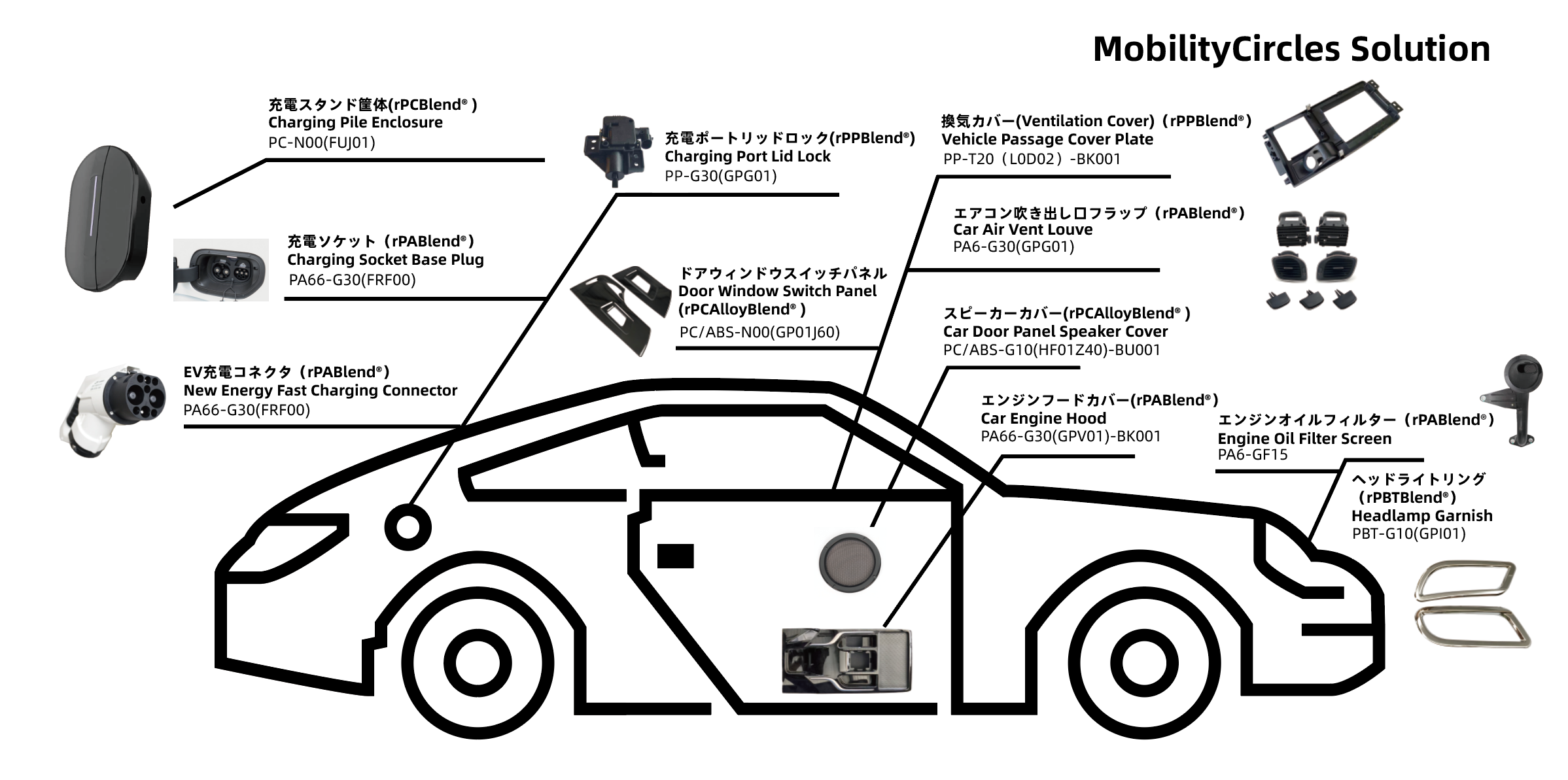
CircleBlend® is consistently committed to delivering optimal solutions that perfectly address customer needs. In response to client requirements for special material properties or specific colors, the company provides customized product services and develops high-quality, tailored solutions.